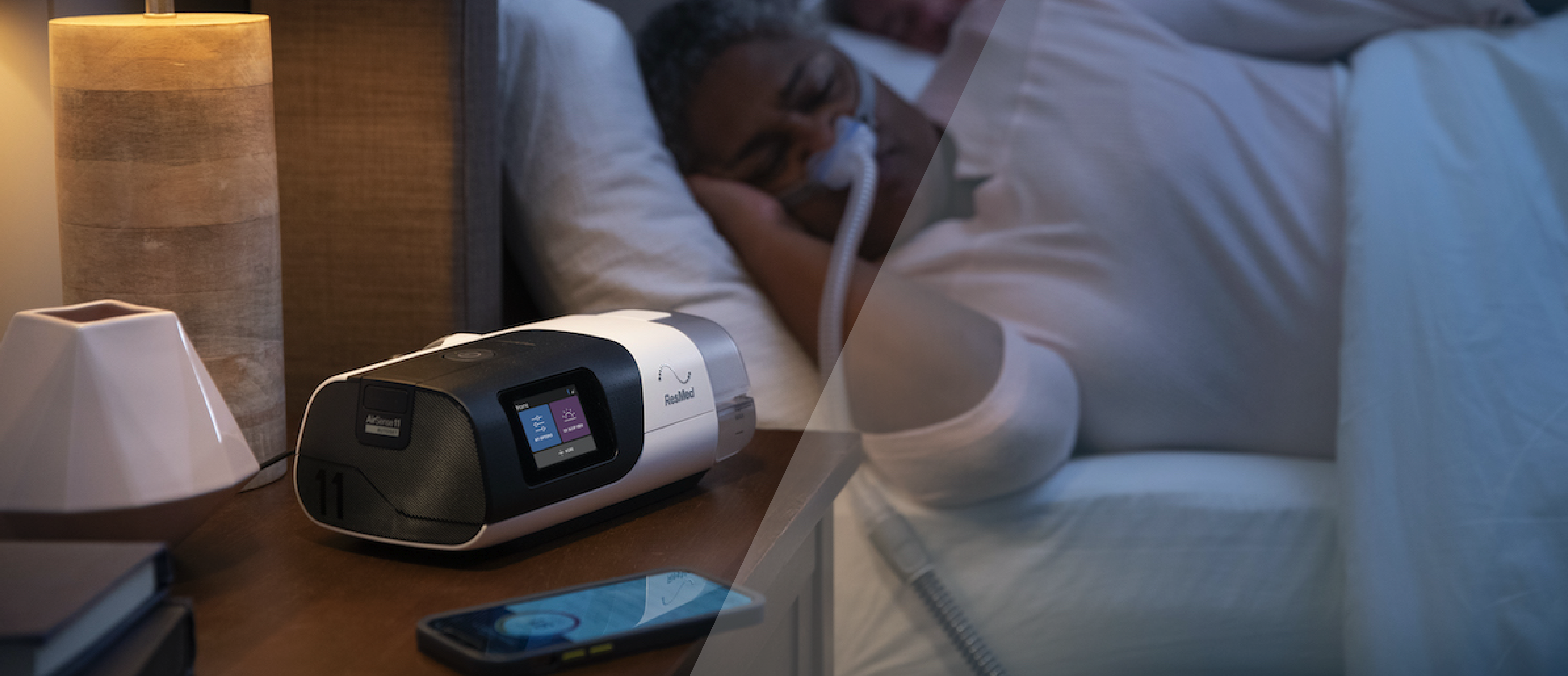
Choosing between a BiPAP machine and a CPAP machine comes down to your diagnosis and how your body responds to therapy. Both devices treat sleep apnea by delivering pressurized air to keep your airway open while you sleep. However, they work differently, and using the wrong one can make therapy harder than it needs to be. This guide explains the differences, the benefits, and who should use each device.
What Is a CPAP Machine?
CPAP stands for Continuous Positive Airway Pressure. A CPAP machine delivers a single, steady pressure level all night long, whether you are breathing in or out. It is the standard first treatment for obstructive sleep apnea (OSA).
CPAP machines are simple, widely available, and covered by many insurance plans. Most people with mild to moderate OSA do very well with CPAP therapy. Learn more about how CPAP therapy treats sleep apnea.
Modern CPAP machines are quieter and more comfortable than older models. Many include auto adjusting pressure (called APAP), heated humidifiers, and data tracking via Bluetooth or SD card.
What Is a BiPAP Machine?
BiPAP stands for Bilevel Positive Airway Pressure. Unlike CPAP, a BiPAP machine uses two separate pressure settings. One setting is for inhaling (IPAP) and a lower one is for exhaling (EPAP). This bilevel approach makes breathing feel more natural, especially for people who struggle to exhale against constant pressure.
BiPAP machines are typically prescribed when CPAP therapy has not worked well, when high pressure settings are required, or when the patient has a condition beyond simple obstructive sleep apnea. Additionally, BiPAP is often used for central sleep apnea, COPD, congestive heart failure, and certain neuromuscular conditions.
Because BiPAP machines are more complex, they are generally more expensive than standard CPAP devices. However, for patients who need them, the comfort and effectiveness difference can be significant.
BiPAP vs CPAP: Key Differences at a Glance
| Feature | CPAP | BiPAP |
| Pressure type | Single continuous pressure | Two pressures (inhale and exhale) |
| Best for | Obstructive sleep apnea | Complex or central sleep apnea, COPD, high pressure needs |
| Comfort | Good for most users | Easier to exhale, better for some users |
| Cost (approx.) | ADP grant of $415.50 applies (Ontario) | ADP grant of $712.50 applies (Ontario) |
| Prescription needed? | Yes | Yes |
| Insurance coverage | Commonly covered | Covered with medical justification |
Who Needs a BiPAP Instead of CPAP?
Your sleep specialist will recommend a BiPAP machine if CPAP therapy is not controlling your apneas. They may also suggest it if your required pressure is very high (above 15 cm H₂O), or if you have a secondary respiratory condition. Some people simply find it impossible to exhale against constant CPAP pressure. This is sometimes called complex sleep apnea, and BiPAP often resolves it.
Central sleep apnea is another reason to move to BiPAP. In central sleep apnea, your brain fails to send the right signals to your breathing muscles. A standard CPAP machine cannot address this. A BiPAP or more advanced ASV (Adaptive Servo Ventilation) device is required instead.
In contrast, if you have straightforward obstructive sleep apnea with a low to moderate pressure requirement, a CPAP machine is almost always the right first choice. It is simpler, cheaper, and easier to find support for. CPAP Central carries both CPAP and BiPAP devices across our Ontario locations.
What About Auto Adjusting Machines (APAP)?
APAP machines sit between standard CPAP and BiPAP in terms of complexity. They deliver a single pressure like CPAP but automatically adjust it throughout the night based on your breathing. Therefore, if your pressure needs vary due to sleep position, alcohol use, or REM sleep, APAP handles these changes automatically.
APAP is a popular choice for people who are newly diagnosed and whose ideal pressure has not been precisely set yet. For example, many CPAP Central patients start on APAP to establish their optimal range, then switch to a fixed pressure once their data is clear. Additionally, APAP gives your care team useful data to fine tune your therapy over time.
That said, APAP is not the right fit for everyone. Your sleep specialist will guide you toward the best option based on your sleep study results and medical history.
Frequently Asked Questions
Can I switch from CPAP to BiPAP on my own?
No. BiPAP machines require a prescription and a specific pressure setting from your sleep specialist. Switching without medical guidance could leave your sleep apnea undertreated. Talk to your doctor if you feel CPAP is not working for you.
Is BiPAP better than CPAP for sleep apnea?
Not necessarily. CPAP is more effective for most obstructive sleep apnea patients. BiPAP is better for specific conditions, such as central sleep apnea, COPD, or cases where patients cannot tolerate high CPAP pressure. Your diagnosis determines which device is right for you.
Does insurance cover BiPAP machines in Canada?
Many private insurance plans cover BiPAP machines with a valid prescription and documented medical need. Coverage varies widely by plan. Ask your insurer about your specific benefit and whether pre approval is required. In Ontario, the Assistive Devices Program (ADP) also provides a grant of $712.50 toward the cost of an eligible BiPAP device for qualifying patients.
Is a BiPAP machine louder than CPAP?
Modern BiPAP machines are very quiet, typically under 30 decibels. Most users find the sound comparable to a CPAP machine. Noise is rarely a distinguishing factor between the two device types.
How do I know which device is right for me?
A sleep study is the starting point. Your results will tell your doctor whether you have obstructive or central sleep apnea and what pressure range you need. From there, your specialist can prescribe the right device with confidence.
Talk to a Specialist Before You Choose
Understanding the difference between a BiPAP machine and a CPAP device is the first step toward better sleep. The next step is getting the right prescription and fitting for your specific needs. At CPAP Central, our team helps you navigate your options with expert guidance. Contact CPAP Central to speak with a sleep therapy specialist today.