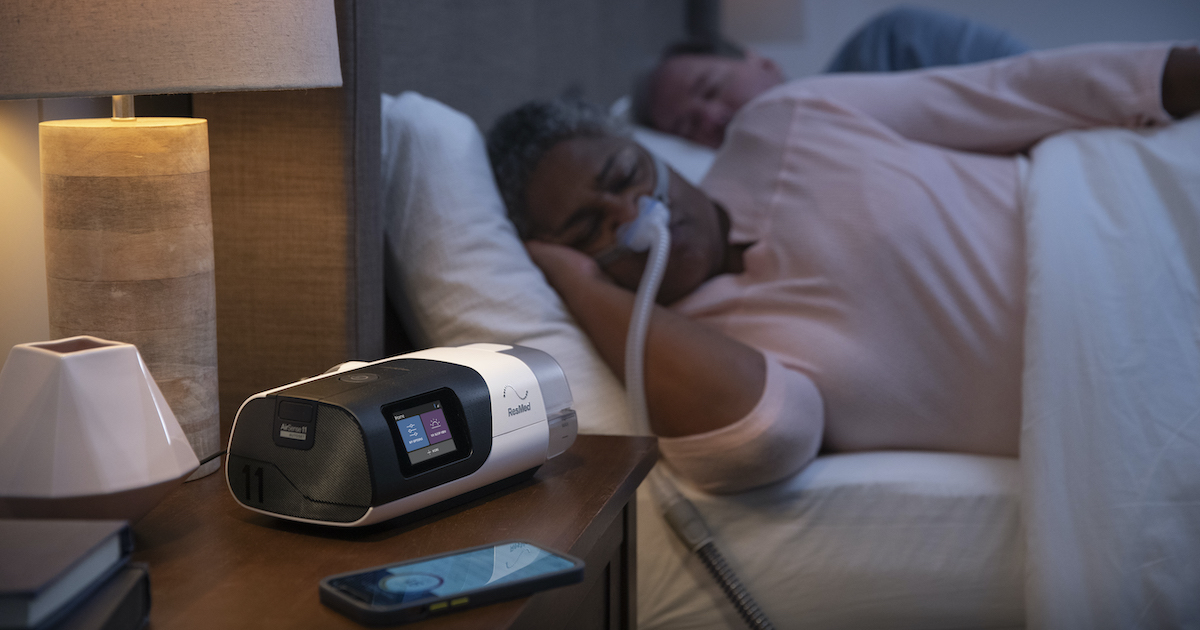
Use distilled water in your CPAP humidifier. CPAP Central recommends distilled water for both Standard and Cleanable ResMed water chambers, in line with ResMed’s recommendation. Check your device guide for filling, cleaning and handling instructions, and ask your care team if anything is unclear.
Once you know what your guide asks for, the rest comes down to reading labels carefully, handling the tub well and planning ahead when you travel.
Two AirSense 11 tubs, one water recommendation
The AirSense 11 can be used with either a HumidAir 11 Standard tub or a HumidAir 11 Cleanable tub. The chambers differ in their design and cleaning instructions:
The Standard tub has a white thumb grip, is intended for a single patient, and should be filled with distilled water only.
The Cleanable tub has a grey thumb grip and can be reprocessed for multi-patient use. CPAP Central recommends filling it with distilled water too.
The thumb grip colour can help you identify your tub. If you are not sure which one you have, check the paperwork that came with your equipment or ask the team that set you up. The chamber type does not change CPAP Central’s distilled-water recommendation. Follow your model’s guide for its filling and cleaning routine.
Reading water labels in Canadian stores
Bottled water labels use terms that sound similar but mean different things. Choose by the exact wording your device guide uses.
Distilled water is made by boiling water, collecting the steam and condensing it back into liquid. Dissolved minerals stay behind in the boiling vessel, so the result is very low in dissolved solids. If your guide says distilled, buy a product that says distilled on the label.
Purified water is a broader term. It can describe water treated by distillation, reverse osmosis, deionisation or other methods. A label that only says purified does not tell you which process was used, so it may not meet an instruction that calls for distilled water.
Spring water comes from an underground source and keeps its naturally occurring minerals. Water from a home filter pitcher or tap filter has had some substances reduced, but generally still contains dissolved minerals. Softened water has gone through an ion exchange that swaps calcium and magnesium for sodium. None of these is the same as distilled water.
Boiling tap water in a kettle does not remove its dissolved minerals. Boiled tap water and distilled water are different products.
Whatever you buy, the AirSense 11 guide says not to use additives such as scented oils or perfumes in the tub. Plain water of the specified type, with nothing added, is what the guide calls for.
Why the water type matters for the tub
When water evaporates in a heated tub, minerals that were dissolved in it are left behind. Over time this can build up as a white powder on the inside surfaces. The AirSense 11 guide includes its own instructions for removing white powder deposits, and it tells users to replace the tub if it is leaking, cracked, cloudy or pitted, or if the seal is cracked or torn. Using the water your guide specifies is the simplest way to keep the tub in the condition the manufacturer intends.
Everyday handling of an AirSense 11 tub
If you use an AirSense 11, its guide sets out a routine that is easy to follow:
Remove the tub from the device before adding water.
Use water at room temperature, never hot water, and fill only to the maximum line. The tub holds up to 380 mL.
Each day, empty the tub, wipe it with a clean disposable cloth and let it dry out of direct sunlight before refilling with the correct water type.
Each week, wash the tub in warm water with mild dishwashing liquid, or with the alternative solution the guide describes, then rinse and air dry.
The guide also cautions against bleach, chlorine, aromatic solutions, moisturising or antibacterial soaps and scented oils, because they can damage the tub and affect humidifier performance. Other models have their own routines, which may differ, so follow the guide that came with your device. ResMed’s cleaning page has further detail for its equipment.
Storing water at home
Keep your water in its original sealed container, or a clean container with a lid, and follow any storage guidance on the packaging. Pour what you need for the night into the tub rather than dipping into the jug. Avoid topping up yesterday’s water; the AirSense 11 routine is to empty, wipe and dry the tub each day, then refill with fresh water.
If you run out
If you run out of distilled water, contact your care team or CPAP Central before substituting another type. Our recommendation remains distilled water for both Standard and Cleanable chambers. Ask your team how to manage humidification until you can obtain more, and follow the instructions for your device. Our FAQ page covers other general supply questions.
Planning water for travel
Travel is where water choices tend to get tricky. A few habits help:
Work out how much water you need before you leave. With a 380 mL tub filled nightly, a week away needs roughly 2.7 litres of the correct type, plus a little extra.
Check whether stores at your destination sell it, especially in smaller communities, rather than assuming you will find it.
Empty the tub before you pack the device. The AirSense 11 guide says not to use the device with water in the tub while in transit, such as on a plane or in a vehicle.
If you travel often, ask CPAP Central whether a travel setup with a different humidification option would suit your therapy. Some travel devices handle humidification differently from home machines. Our education page has general reading on travelling and living with CPAP therapy.
Questions about your tub or water
If you cannot tell which tub you have, your tub looks cloudy or pitted, or you are not sure which water your device needs, the CPAP Central team can help you sort it out. Get in touch through our contact page or visit a store listed on our locations page.