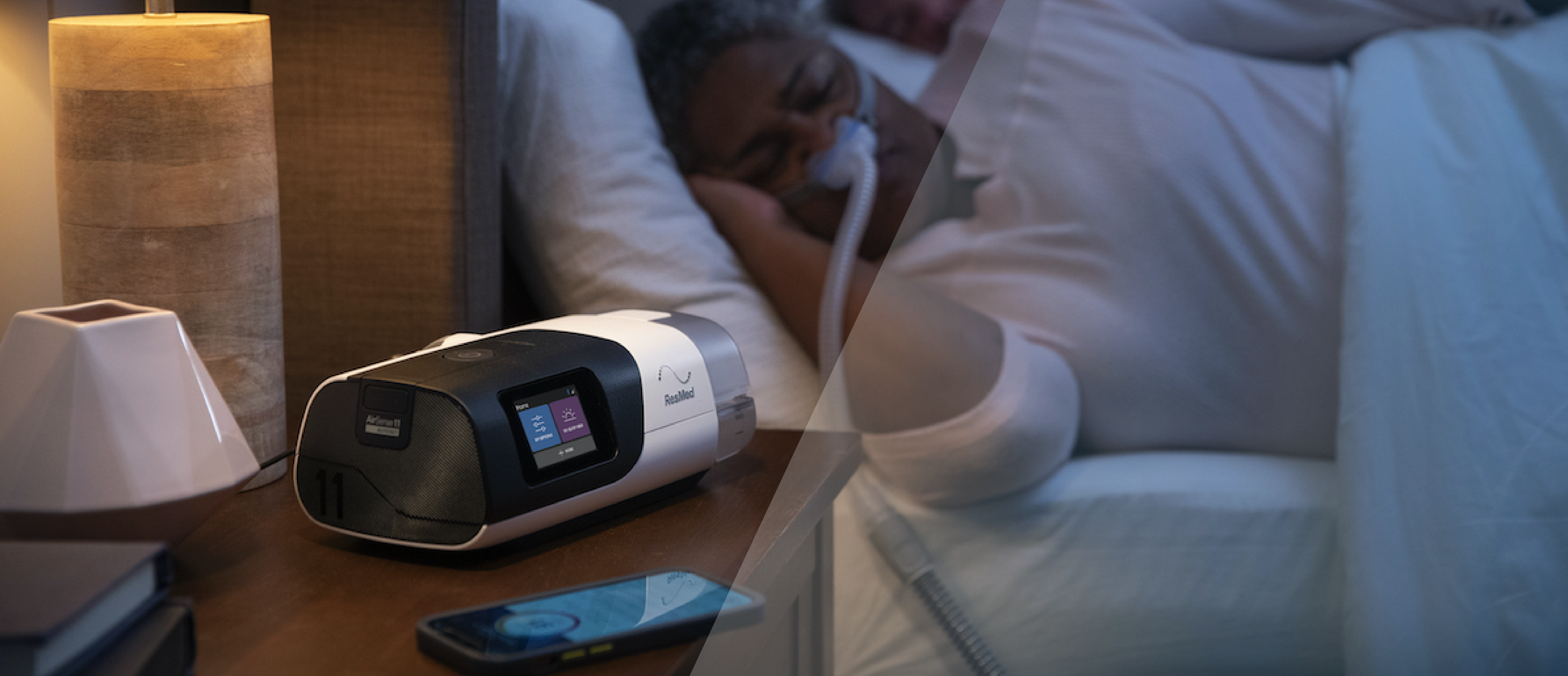
Rainout is the name for water that collects inside your CPAP tubing or mask. You might hear a gurgle in the hose, feel droplets on your face, or find a small puddle at the lowest point of the tube in the morning. It happens when warm, humidified air from your machine cools on its way to the mask and some of its moisture turns back into liquid.
The good news is that rainout usually has a cause you can find with a little observation. The steps below start with what to watch for, then move to the settings and setup changes your device guide may allow.
Why humidified air leaves water behind
Your humidifier warms water in its tub and adds that moisture to the pressurised air. Warm air can hold more water vapour than cool air. As the air travels through the hose, it gives up heat to the room. If the tube cools enough, the air inside can no longer hold all of its moisture, and droplets form on the inner wall. Those droplets run downhill and gather wherever the tube dips.
Three things shape how much water you see: how much moisture the humidifier adds, how much the air cools along the way, and the path the tube takes between the machine and your face. A change in any of them can tip a comfortable setup into one that produces rainout.
Start by noticing when and where it happens
A few nights of simple observation will tell you more than guessing. Look at these details:
- When the gurgling starts. Water that appears early in the night points to a different situation than water that builds up toward morning, when many homes are at their coolest.
- Where the water collects. Note whether it pools at a low loop in the tube, near the mask connection, or inside the mask itself.
- What changed recently. A new season, a lower thermostat setting at night, a window opened for fresh air, a different humidity level, or moving the machine to another spot can all alter conditions.
For example, if the gurgling only shows up after you started turning the heat down at bedtime, that timing is a strong clue. Write down what you notice so you can describe it clearly if you need help.
Check the basic setup
Some rainout comes from setup rather than settings. ResMed’s AirSense 11 user guide gives several instructions that apply here, and other manufacturers include similar guidance in their own manuals.
- Place the machine on a stable, level surface lower than your head. The AirSense 11 guide gives this instruction specifically to help keep water from running into the tubing and mask.
- Fill the tub only to its maximum line. Overfilling can let water reach the tubing.
- Use water at room temperature when you fill the tub. The AirSense 11 guide advises against filling with hot water.
- Route the tube away from cold surfaces such as an exterior wall, a window or an air vent, and avoid deep loops where water can settle.
Adjust comfort settings using your device guide
Humidity and tube temperature are comfort settings on many machines, and your user guide explains which ones you can change. On the AirSense 11, the troubleshooting section links droplets in the mask and tubing to two possible causes: a humidity level that may be set too high, or a tube temperature that may be set too low. Its suggested responses are to lower the humidity level or raise the tube temperature.
Make one change at a time and watch what happens over the following nights. If you lower humidity and then wake with a dry nose or mouth, that tells you something useful about where your comfortable range sits.
Heated tubing and climate control features work together on some machines. On the AirSense 11, the Climate Control feature is only available when ClimateLineAir 11 heated tubing and the humidifier tub are both attached. In its Auto setting, ResMed describes it as protecting against rainout. In Manual, the guide says rainout protection is not guaranteed and suggests trying a higher tube temperature first, then lower humidity if the air feels too warm. Heated tubes are model-specific, and the AirSense 11 guide lists ClimateLineAir 11 and ClimateLineAir 11 Oxy as the only heated tubing compatible with that device. If you use another machine, check its guide for compatible options.
Dealing with water that is already in the tube
If you wake to water in the hose, stop therapy, disconnect the tube and let the water drain out before you continue. Check that the tub is seated properly and not overfilled. Clean and dry the tubing on the schedule your guide sets out. ResMed’s equipment cleaning page covers its tubing, and the AirSense 11 guide describes washing tubing in warm water with mild dishwashing liquid and letting it dry away from direct sunlight.
Two safety points apply throughout. Keep your mask vents clear and uncovered, because they let exhaled air escape, even if water is collecting near them. And leave your prescribed pressure settings alone; pressure changes belong with your treating team.
When to ask for help
Rainout on its own does not prove or rule out a problem with your equipment. Contact CPAP Central or your care team if water keeps appearing after you have checked the setup and comfort settings, if water reaches the machine itself, or if the device starts behaving differently or making sounds you have not heard before. The AirSense 11 guide advises stopping use and contacting your care provider in those last situations.
When you reach out, share your notes: when the water appears, where it collects, your current humidity and tube temperature settings, and anything that changed before it started. That gives the team a clear starting point. You can reach CPAP Central through our contact page or find a store on our locations page. For general reading on living with therapy, our education page and FAQ page are good places to browse.